

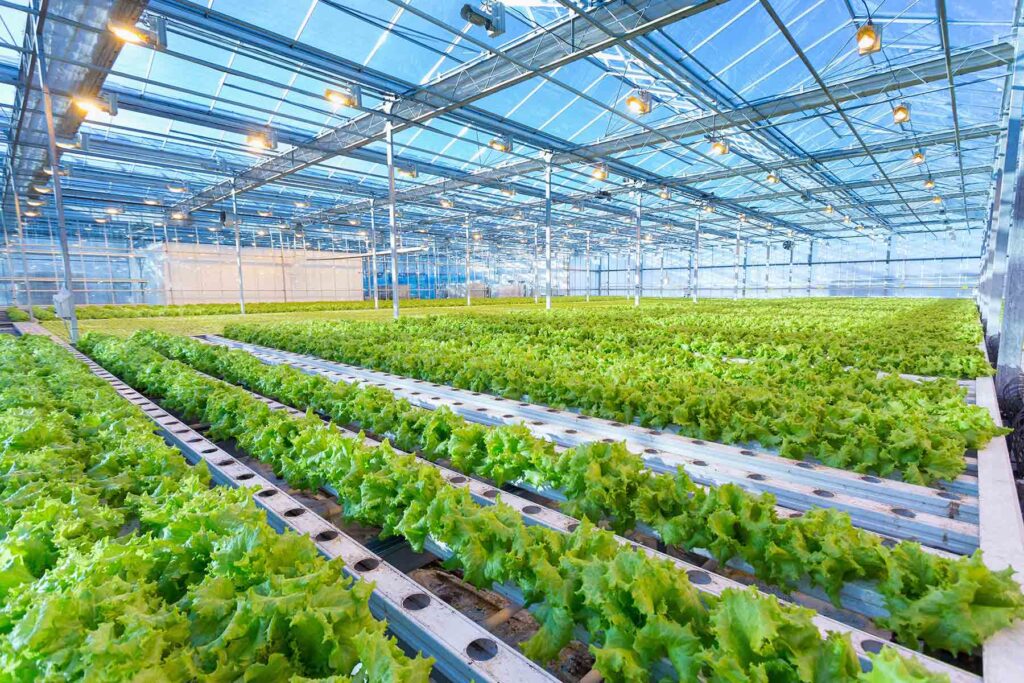
Greenhouse cooling systems have always been essential to commercial production, but the way growers evaluate cooling performance has changed. For years, success was measured by how well a system managed average summer temperatures. Today, that metric alone doesn’t always capture how cooling systems perform under real operating conditions.
Modern greenhouse environments are shaped by variability. Heat arrives faster, peaks higher, and behaves less predictably than it did when many cooling systems were designed. As a result, professional growers now focus on how cooling systems behave under stress, during heat spikes, uneven solar load, and peak demand periods when conditions change quickly.
This article takes a comprehensive look at commercial greenhouse cooling from a design and performance perspective. Rather than focusing on individual products or setup steps, it examines how greenhouse cooling systems work, how they scale, and how they should be evaluated in real-world greenhouse operations using strong greenhouse climate control fundamentals and practical greenhouse temperature control expectations.
The Modern Heat Challenge in Commercial Greenhouses
Heat inside a greenhouse does not behave like heat outdoors. Solar radiation passes through glazing, warms internal surfaces, and becomes trapped. Air movement, structure design, and crop density all influence how quickly temperatures rise and how long heat lingers. This is why greenhouse heat management matters as much as equipment selection.
What has changed in recent years is the speed of these temperature shifts. Heat spikes now occur more frequently and develop more rapidly. A short break in cloud cover, a change in wind direction, or a sudden rise in outside temperature can push internal conditions out of range within minutes.
For crops, this matters. Plants respond to temperature changes as they occur, and those responses can influence performance even after conditions stabilize. Even brief exposure to elevated temperatures can increase respiration, alter transpiration behavior, and reduce photosynthetic efficiency. These effects may not be immediately visible, but they influence growth rates, uniformity, and downstream performance.
For growers managing commercial greenhouse cooling, these events reveal the limits of systems designed around historical climate patterns. Cooling performance is no longer defined by steady-state operation. It is defined by how systems behave during extremes and how well greenhouse cooling performance holds under peak demand.
How Greenhouse Cooling Systems Remove Heat
To evaluate cooling performance accurately, it helps to understand how greenhouse cooling systems remove heat from the growing environment.
Heat enters a greenhouse primarily through solar radiation and warm outside air. Cooling systems counter this heat in two fundamental ways: by moving warm air out of the structure and by absorbing heat through evaporation. These concepts sit at the core of greenhouse climate control.
Air movement plays a critical role in temperature distribution. Ventilation and circulation fans help prevent hot spots and move warm air toward exhaust points. However, airflow alone does not eliminate heat. It redistributes it. If incoming air is already warm, air exchange provides limited relief during peak conditions, especially in large structures.
Evaporative cooling removes heat by using water to absorb energy as it changes from liquid to vapor. This process directly lowers air temperature, making it one of the most effective tools in greenhouse environments when conditions allow. The efficiency of evaporative cooling depends on droplet size, distribution, humidity, and how quickly evaporation occurs.
Most greenhouse climate control strategies rely on a combination of air movement and evaporation. Performance depends on how quickly cooling engages, how evenly cooling is distributed across the crop zone, and how well systems scale as greenhouse size increases, especially for cooling large greenhouses and maintaining consistent greenhouse temperature control.
Common Approaches to Greenhouse Cooling
Commercial greenhouses rarely rely on a single cooling method. Instead, they use layered approaches to manage varying conditions throughout the day and season. The goal is to maintain stable greenhouse temperature control and protect crop performance.
Ventilation-based cooling removes heat by exchanging internal air with outside air. This approach works well when outside temperatures are lower than internal conditions and airflow can be maintained consistently. During extreme heat, ventilation effectiveness drops as the temperature difference between inside and outside narrows.
Evaporative cooling approaches use water to absorb heat from the air and are widely used in cooling systems for greenhouses, particularly in hot, dry climates. These systems can deliver significant temperature reductions, but their performance depends on humidity, airflow, and how evenly cooling is distributed.
Fog and mist-based cooling systems introduce fine droplets that evaporate quickly, absorbing heat directly from the surrounding air. Because evaporation occurs throughout the space, these systems can cool closer to the crop and reduce temperature gradients across large areas. This supports stronger greenhouse cooling performance under variable conditions.
Most commercial facilities combine ventilation, evaporative cooling, shading, and automation to manage different heat conditions. Hybrid designs provide flexibility and redundancy, allowing growers to respond more effectively as heat loads change throughout the day. This approach improves greenhouse cooling efficiency and supports cooling performance at scale.
For a deeper overview of approaches growers use during hot seasons, link here to: “Effective Greenhouse Cooling Methods for Hot Summer Months.”
Cooling Performance at Commercial Scale
Cooling behavior changes as greenhouses get larger. Increased air volume, higher thermal mass, and longer distances between cooling sources and crop zones all influence performance. Scale puts pressure on greenhouse cooling design and exposes weak greenhouse cooling distribution.
In large commercial and multi-span greenhouses, cooling is rarely uniform. Centralized systems may stabilize some areas quickly while others lag behind. These differences become most visible during peak heat, when systems are running continuously and still struggle to fully recover.
As greenhouse size increases, heat can accumulate faster than it can be removed. Cooling systems may operate at full capacity without ever bringing conditions fully back to setpoint during the hottest part of the day. This does not necessarily indicate system failure, but it highlights the limits of certain designs at scale and the importance of greenhouse cooling performance measured at the crop zone.
Evaluating performance at the crop level, not just at central sensors, is essential in large operations. What matters most is how conditions feel where plants are growing, not just what averages suggest. This perspective helps growers identify whether cooling large greenhouses requires improved distribution, faster engagement, or both.
Designing Cooling Systems for Heat Spikes
Many greenhouse cooling systems were designed using climate data that emphasized average conditions rather than extremes. As heat spikes become more common, this approach leaves little margin for short-term events.
Designing for heat spikes requires accounting for peak heat load, uneven solar exposure, and rapid temperature changes. It also requires recognizing that response speed and greenhouse cooling distribution can be just as important as total cooling capacity. This is where greenhouse cooling efficiency starts to depend on system behavior, not just equipment size.
Systems that respond slowly may eventually restore conditions, but the delay can still expose crops to stress. Cooling that engages quickly and reaches the crop zone evenly helps limit temperature swings before they begin to affect crop performance. Strong greenhouse cooling design supports steadier operation and better outcomes during extremes.
Automation plays a role, but controls alone do not solve response challenges. Sensor placement, control logic, and system layout all influence how quickly cooling engages. Poor placement or delayed logic can slow response even when sufficient cooling capacity exists.
Evaluating Cooling Performance in Real Operations
Cooling limitations often reveal themselves during the most demanding conditions. Growers may notice frequent temperature alarms, long recovery times after mid-day peaks, or zones that consistently run warmer than others. These are practical indicators of weakening greenhouse cooling performance.
These patterns suggest that cooling is falling behind the rate of heat gain. Even when greenhouse temperature control appears acceptable on average, variability across the structure can still affect crop performance and uniformity. This is where growers start to question system layout, control logic, and overall greenhouse cooling efficiency.
Operational preparation also matters. System startup, seasonal checks, and routine maintenance all influence how reliably cooling performs during peak heat. Small issues that go unnoticed early in the season often become limiting factors during the hottest days, especially in complex commercial greenhouse cooling environments.
Asking practical questions helps clarify performance:
- How quickly does cooling engage when temperatures rise?
- How evenly does cooling reach the crop zone?
- How does the system behave during peak heat events and peak heat load conditions?
For seasonal preparation steps and operational foundations, link here to: “Greenhouse Cooling Fog System Startup Guide: Setting the Foundation for High-Performance Operation.”
Cooling, Crop Stability, and Uniformity
Cooling performance affects more than temperature readings. It shapes how stable the growing environment remains throughout the day. Better greenhouse heat management supports steadier crop development and fewer downstream issues.
Crops respond best to consistent conditions. Large swings, even if short, force plants to divert energy toward stress response rather than growth. Over time, this leads to uneven development, delayed finishing, and reduced uniformity, especially in sensitive growth stages.
Effective greenhouse cooling solutions help maintain stable conditions that support predictable growth and scheduling. This stability matters in high-value crops where uniformity drives labor efficiency, harvest timing, and quality outcomes.
For a deeper plant-health view of evaporative fog cooling, link here to: “Fogging System for Greenhouses: How Evaporative Fog Cooling Impacts the Health of Your Crops.”
Where Greenhouse Cooling Is Headed
As climate variability increases, greenhouse cooling systems are evolving toward faster, more distributed, and more responsive designs. The focus is shifting from brute-force capacity to precision and control. Growers increasingly evaluate greenhouse cooling performance through the lens of stability and uniformity, not just peak output.
Future cooling strategies will emphasize response speed, uniform delivery, and tighter integration with broader greenhouse climate control systems. Cooling will increasingly support plant health and production consistency rather than simply reacting to heat. This direction aligns with stronger greenhouse cooling efficiency and better cooling performance at scale.
Cooling for the Conditions You Actually Face
Greenhouse cooling systems have always been part of commercial production, but the conditions they are asked to manage have changed. Heat arrives faster, behaves less predictably, and places greater pressure on systems during short, uneven events that sit outside typical operating patterns.
Evaluating cooling through the lens of real-world performance shifts the focus away from averages and toward how systems behave when conditions change quickly. Response speed, distribution across the crop zone, and overall stability become defining factors.
When cooling strategies account for how heat actually moves through the greenhouse, growers are better positioned to identify performance gaps before they affect crops. Systems designed and evaluated with response, distribution, and stability in mind support more consistent temperature control, stronger heat management, and reliable operation when conditions are most demanding.
That is what ultimately defines effective greenhouse cooling today.