

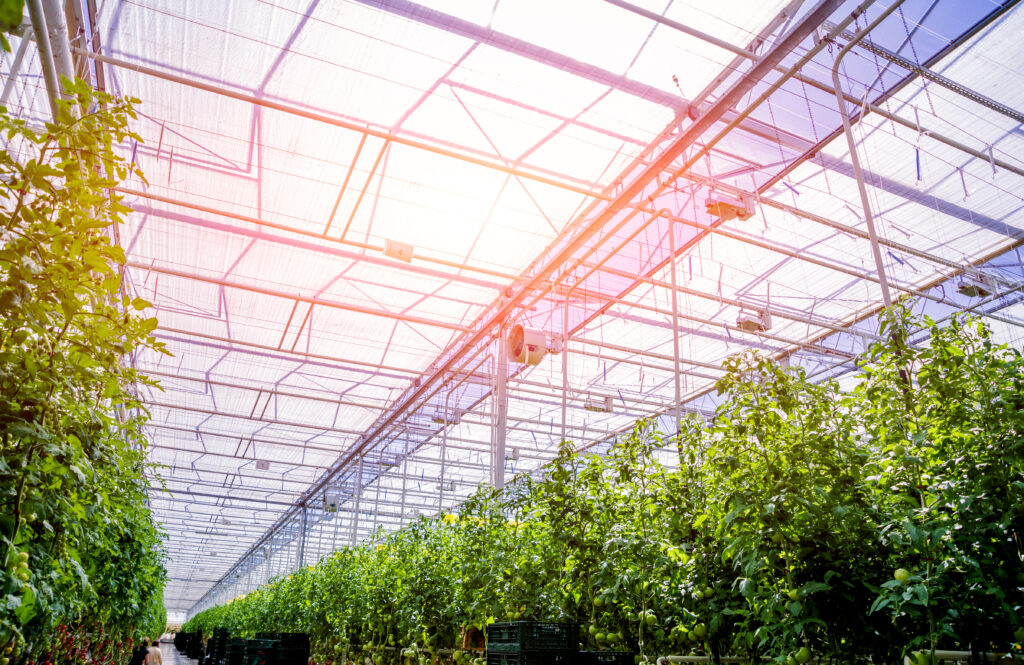
In commercial greenhouse operations, heat is rarely a surprise. Professional growers understand seasonal temperature patterns, solar load, and how quickly conditions can change inside a structure. Greenhouse cooling systems are sized, installed, and maintained with those realities in mind. Yet even well-run facilities still struggle during heat spikes in greenhouses.
The issue is not whether cooling exists. It is how quickly cooling reacts when conditions shift faster than expected. This is where greenhouse cooling response time has become a defining factor in modern greenhouse cooling performance.
As climate variability increases, sudden greenhouse heat spikes are placing new demands on greenhouse environments. Systems designed around steady operating conditions are now being tested by short, intense temperature increases that develop faster than many greenhouse cooling strategies were originally intended to respond.
Why Heat Spikes Expose Greenhouse Cooling System Limits
Heat spikes behave differently than sustained greenhouse heat. They develop rapidly, often within minutes, and create an immediate imbalance between incoming heat load and cooling output. A brief break in cloud cover, a shift in wind, or a sharp rise in outside temperature can push internal greenhouse temperatures out of range before cooling systems fully engage.
In most greenhouses, the environment changes first. Air temperatures rise, surfaces absorb heat, and the crop zone temperature responds immediately. Greenhouse cooling systems react only after sensors detect the increase and control logic initiates a response.
This delay is where greenhouse cooling limitations appear. The challenge is rarely total cooling capacity. Instead, it is the speed at which heat enters the structure compared to how quickly cooling output begins to offset it.
Cooling Capacity vs. Cooling Speed
Greenhouse cooling performance is often discussed in terms of cooling capacity, how much heat a system can remove over time. That metric describes steady-state operation, not protection during sudden environmental change.
Cooling response time reflects something different. It describes how quickly cooling becomes effective once temperatures begin to rise. During a rapid temperature rise, cooling response speed becomes the limiting factor.
A system may eventually restore target conditions, but the delay between heat gain and cooling effect allows stress to accumulate. In short heat events, recovery time matters less than how much temperature deviation occurs before stabilization begins.
This distinction is critical when evaluating greenhouse cooling performance under real-world conditions.
Why Cooling Falls Behind Across Greenhouse Zones
As greenhouse size increases, response challenges become more spatial than mechanical. Large commercial greenhouses and multi-span greenhouse structures contain greater air volume, higher thermal mass, and longer distances between cooling sources and the crop.
Cooling rarely fails everywhere at once. It falls behind in greenhouse zones.
Areas closer to cooling delivery points may stabilize quickly, while distant sections lag behind. Central sensors may show acceptable averages even as localized greenhouse zones experience elevated temperatures.
During rapid heat gain, these uneven recovery patterns become more pronounced. Greenhouse cooling distribution may be sufficient in total, but delays allow heat to persist longer in certain areas of the structure. This is why cooling large commercial greenhouses quickly remains difficult, even when installed greenhouse cooling capacity appears adequate.
Why Short Heat Events Still Stress Food and Produce Crops
Greenhouse environments are often evaluated using daily or hourly averages. While useful for trend analysis, averages mask the short-term temperature extremes that matter most to crops.
Plants do not respond to averages. They respond minute by minute.
Even brief exposure to elevated temperatures increases plant respiration, alters transpiration behavior, and reduces photosynthetic efficiency. In food crops and produce crops such as tomatoes, cucumbers, peppers, and leafy greens, these responses affect carbohydrate balance, water movement, and overall crop growth efficiency.
While some effects resolve once conditions stabilize, others influence growth rate, crop uniformity, and downstream performance. Delayed flowering, uneven sizing, and inconsistent harvest timing often trace back to short greenhouse heat stress events rather than prolonged heat.
Preventing these impacts depends on how quickly cooling engages and stabilizes conditions at the crop level.
What Fast-Responding Greenhouse Cooling Looks Like
Fast-responding greenhouse cooling systems behave differently from conventional approaches. Instead of relying on gradual air exchange or delayed saturation, they focus on immediate heat removal near the crop zone.
These systems activate quickly, modulate output smoothly, and minimize the gap between heat gain and cooling response. Cooling delivery occurs closer to where crop heat stress develops, reducing the duration and intensity of temperature swings.
During heat spikes, this responsiveness limits stress accumulation and helps maintain tighter greenhouse temperature control during peak demand periods.
High-Pressure Fog Cooling and Heat Spike Management
High-pressure fog cooling systems change how cooling is delivered inside the greenhouse. Rather than waiting for air to move across long distances or for cooling media to saturate, fog systems introduce ultra-fine droplets that evaporate almost instantly.
As droplets evaporate, they absorb heat directly from the surrounding air. Cooling begins immediately when the system activates, not minutes later. Because fog is distributed throughout the space, cooling occurs closer to the crop and more evenly across greenhouse zones.
That behavior has been shown in greenhouse fog cooling research, where fine droplets evaporate rapidly, pull heat out of the air efficiently, and help limit temperature differences across the space during fast heat increases.
This rapid, distributed cooling response is why high-pressure fog cooling is particularly effective for heat spike management in greenhouses, especially during periods of peak heat load.
Designing Greenhouse Cooling Systems for Heat Spikes
Many greenhouse cooling systems were designed using historical climate data that emphasized seasonal averages rather than short-term temperature extremes. As heat spikes become more frequent and less predictable, this approach leaves little margin for rapid events.
Designing for current conditions means treating cooling response speed, cooling distribution, and control strategy as core performance factors. Systems must engage quickly, reach the crop zone evenly, and adjust smoothly as conditions change.
Capacity still matters. But energy-efficient greenhouse cooling increasingly depends on how systems behave during the first minutes of a temperature rise, not how long they can operate at full output.
Growers evaluating greenhouse cooling solutions often look for systems that respond quickly, distribute cooling evenly across zones, and support stable environmental control during peak conditions. You can see how these approaches are applied in practice on the MicroCool greenhouse cooling systems page.
For a broader perspective on how greenhouse cooling systems are designed and evaluated for commercial performance, explore “Greenhouse Cooling Systems: Designing for Heat Spikes and Commercial Performance.”
Why Greenhouse Cooling Response Speed Now Defines Performance
Professional growers already understand what goes wrong during greenhouse heat spikes. The challenge is not awareness. It is alignment between how fast conditions change and how fast greenhouse cooling systems respond.
As climate variability continues to increase, greenhouse cooling performance will be defined less by total capacity and more by cooling response speed. Systems that react quickly protect crops, stabilize environments, and reduce operational stress.
In modern commercial greenhouse cooling, performance is no longer just about capacity.
It is about keeping pace with change.