

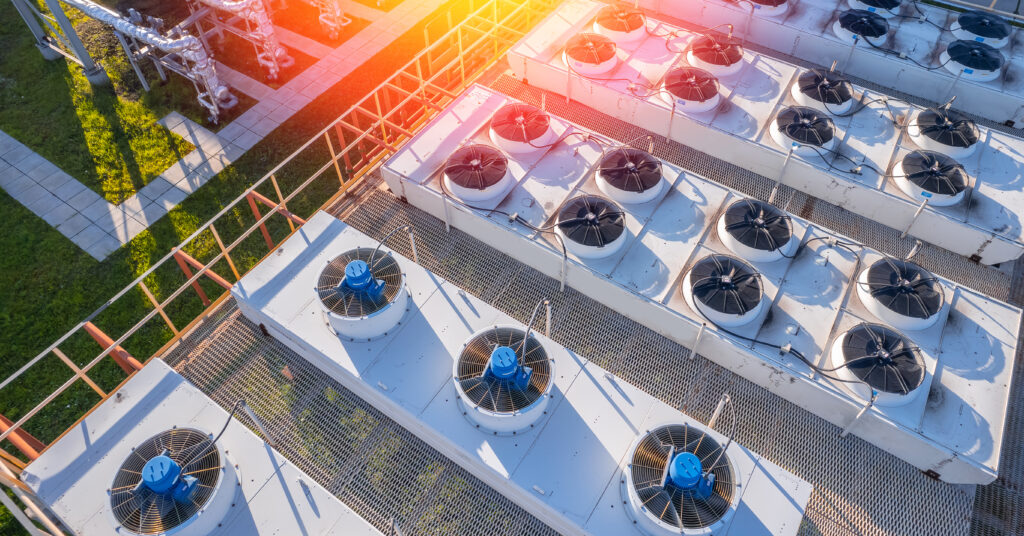
Air‑cooled HVAC systems often operate comfortably through much of the year. Then summer arrives. Temperatures climb, rooftop units begin drawing more amperage, and systems that seemed stable in spring suddenly operate much closer to their limits.
This change is not unusual. It is the predictable result of how air‑cooled condensers reject heat. As outdoor temperature rises, the margin between ambient air and condensing refrigerant temperature shrinks. When that margin tightens, heat rejection becomes more difficult. Head pressure rises. Compressor workload follows.
In facilities such as telecom hubs, data centers, manufacturing plants, and distribution centers, these conditions become visible quickly. Cooling systems run longer. Electrical demand increases. Operators often begin seeing elevated discharge pressures during the hottest hours of the day.
Improving air‑cooled condenser performance during extreme heat therefore becomes critical for maintaining reliable system operation.
How Extreme Heat Increases HVAC Energy Use and Mechanical Stress
When outdoor temperatures climb, air‑cooled condensers lose operating margin.
Head pressure rises. Compressor lift increases. Electrical demand follows.
During periods of high head pressure in summer, compressors operate at elevated discharge pressures for extended periods. Sustained operation under these conditions increases wear on internal components such as motors, valves, bearings, and electrical windings. Over time, this added stress can shorten equipment life and gradually reduce system efficiency.
As components experience greater mechanical and thermal strain, compressors must work harder to maintain the same cooling output. The result is higher operating costs, declining performance, and increased likelihood of maintenance or premature equipment replacement. These relationships between condensing pressure, compressor workload, and system efficiency are well documented in the ASHRAE Handbook—Refrigeration, which explains how higher condensing temperatures increase compressor lift and energy demand while accelerating component wear.
For facilities operating continuously, the objective is not simply maintaining setpoints. The goal is protecting system longevity while stabilizing condenser operation and reducing energy use in commercial cooling systems.
Why Air‑Cooled Condensers Lose Capacity in High Temperatures
Air‑cooled condensers rely on a temperature difference between refrigerant and outdoor air to move heat out of the system. As ambient temperatures rise, the condenser becomes less effective at rejecting heat.
The result is measurable condenser capacity loss in high temperatures. Systems run longer to deliver the same cooling output. Across multiple HVAC units, these longer run cycles translate into higher electrical demand and reduced operating margin.
This is rarely an equipment failure. It is simply the physics of heat transfer. However, if condenser conditions are not improved during peak heat events, compressors remain under sustained strain and operating costs increase.
Improving Air‑Cooled Condenser Performance Without Equipment Replacement
 Fortunately, improving air‑cooled condenser performance does not always require replacing HVAC equipment. In many facilities, the most effective approach is improving how heat is rejected at the condenser during high ambient conditions.
Well‑designed intake air cooling systems support better heat rejection by cooling the airflow that passes across the condenser coil. Improving the air temperature around the coil helps control condensing pressure and reduces the load placed on the compressor during peak heat.
One effective strategy involves evaporative cooling for air‑cooled HVAC systems. By introducing fine water droplets into the incoming airstream, evaporation lowers air temperature before it reaches the condenser coil.
In retrofit situations where replacing equipment is impractical, evaporative cooling for air‑cooled HVAC systems provides a practical way to restore lost condenser capacity. This helps facilities regain performance margin while supporting reducing energy use in commercial cooling systems during the hottest operating hours.
Solutions such as MicroCool’s high‑pressure fog systems are engineered specifically for this purpose. By producing ultra‑fine droplets that evaporate rapidly within the condenser airflow, these systems reduce intake air temperature while maintaining precise control and efficient water use.
Comparing Evaporative Cooling Systems for Air‑Cooled Condensers
Several evaporative strategies can reduce condenser intake air temperature. Each approach offers different operational characteristics and should be evaluated based on system design and facility requirements.
Compressed‑Air Atomization Systems
Compressed‑air atomization systems use an air compressor to force water through atomizing nozzles, producing a fine mist that evaporates in the condenser intake airflow. Droplet formation depends on compressed air supply, which requires dedicated compressor capacity.
Because compressed air generation is energy intensive, the electrical demand of the compressor must be included when evaluating system efficiency.
Wet Pad (Media) Systems
Wet pad systems place saturated media at the condenser intake. As condenser fans pull air through the media, evaporation lowers air temperature before it reaches the coil.
This approach works well in dry climates where evaporative potential is high. However, because the media sits directly in the airflow path, it introduces resistance. Fan capacity and airflow conditions should therefore be evaluated carefully.
High‑Pressure Fogging Systems
High‑pressure fogging systems atomize treated water using hydraulic pressure rather than compressed air. The resulting droplets evaporate rapidly within the condenser airflow, lowering intake air temperature before heat exchange occurs.
Because the system relies on a high‑pressure pump instead of an air compressor, electrical demand remains relatively low while airflow resistance is minimal.
When staged correctly, fogging systems respond dynamically to changing ambient conditions and help maintain improving air‑cooled condenser performance during extreme heat.
Water Quality Requirements for Evaporative Condenser Cooling
Water quality plays an important role in long‑term evaporative system performance.
Untreated water contains dissolved minerals that can accumulate on coil surfaces over time. These deposits reduce heat transfer efficiency and restrict airflow.
Using reverse osmosis water for condenser protection helps prevent mineral buildup and supports preventing scale on condenser coils. Clean heat‑transfer surfaces ensure that evaporative cooling continues operating efficiently.
Precision Control Across Multiple HVAC Units
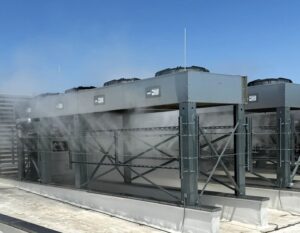 Large facilities rarely operate identical condenser loads across every unit.
Solar exposure, airflow patterns, and equipment utilization vary throughout the day. As a result, applying evaporative cooling uniformly across all condensers is often unnecessary.
Zone‑controlled condenser cooling allows evaporative support to be applied only where temperatures exceed defined thresholds. Staged evaporative cooling engages incrementally as conditions change, creating demand‑driven cooling that aligns water and pump operation with real‑time system demand.
Systems such as MicroCool’s high‑pressure fog technology are designed for this type of deployment. By staging cooling across multiple condensers, facilities can stabilize performance without over‑applying water or pump capacity.
Reducing Energy Use in Commercial Cooling Systems During Extreme Heat
Extreme heat exposes the limits of air‑cooled equipment.
As condenser efficiency declines, compressors work harder and electrical demand increases. Left unmanaged, this cycle narrows operating margin and accelerates equipment wear.
Managing condenser intake conditions helps restore system balance. Lower inlet air temperatures, controlled compressor lift, and clean heat‑transfer surfaces all contribute to improving air‑cooled condenser performance.
In environments that depend on uninterrupted cooling, these improvements extend equipment life, stabilize energy consumption, and support reducing energy use in commercial cooling systems while maintaining reliable performance during extreme heat.