

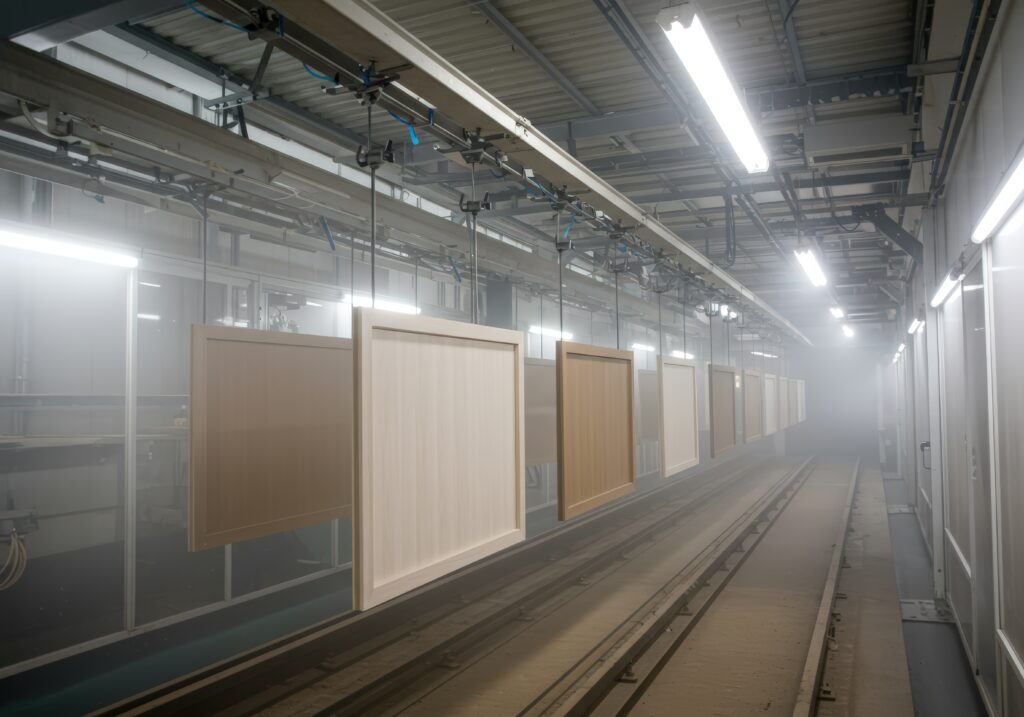
As a woodworking facility owner, you appreciate that a fogging system is not just a technical detail—it’s a cornerstone of your manufacturing process providing proper humidification and dust suppression in woodworking manufacturing doesn’t just improve product quality; it influences the very dynamics of your workshop, enhancing both worker safety and operational efficiency.
Why Humidity Control Matters in Woodworking
Understanding the significance of humidity control in your facility starts with recognizing that wood is hygroscopic. It continuously absorbs and releases moisture based on the surrounding air conditions. Inconsistent woodworking humidity control can have detrimental effects, such as:
- Warping and Splitting: Fluctuating humidity can cause wood to swell or shrink dramatically, jeopardizing the dimensional stability of your products.
- Weak Adhesive Bonds: When adhesives used in woodworking don’t cure properly, it can lead to joint failures and decreased product durability.
- Compromised Aesthetics: Paints and finishes may not adhere correctly, leading to unsightly blemishes and poor end quality.
When humidity levels are stable, you ensure the following:
- Consistent Dimensional Stability of Wood: Your products remain well-formed and ready for assembly, reducing waste and rework costs.
- Reliable Adhesive Performance: Enhanced adhesive bond strength in woodworking means fewer defects and returns.
- High-Quality Surface Finishes in Woodworking: Paints, stains, and coatings are applied evenly, creating visually appealing products that customers love.
The Importance of Adhesives and Humidity in Woodworking
Adhesives are the unsung heroes of the woodworking industry; they hold everything together. However, they are especially sensitive to changes in humidity. In excessively dry conditions, glue may set too quickly, compromising bond strength. Conversely, too much humidity can prevent proper adhesive curing.
By implementing effective humidification systems for woodworking, you can achieve a stable environment for consistent adhesive bond strength. Proper humidity levels during the curing process reduces waste from joint failures and improves production output.
Elevating Finishes through Optimal Humidity Control
Flawless surface finishes are a top priority in woodworking. Humidity plays a critical role in how finishes cure and adhere. Woodworking humidity control can help finishes dry uniformly without issues like cracking or bubbling. Proper curing of sealants and coatings result in longer-lasting products, fewer surface imperfections, and ultimately leading to a more efficient operation with less time spent correcting mistakes.
The Importance of Humidity Control in the Paint Booth
Airborne dust can compromise paint finishes, leading to unsightly blemishes and reduced quality. In a woodworking factory, the paint booth is a critical area where a controlled environment is necessary to achieve flawless surface finishes. Implementing a humidity system in the paint booth effectively pulls that dust to the floor, ensuring a cleaner workspace and allowing for superior paint application and adherence.
Effective air handling systems remove dust and contaminants, as well as, humidification. Energy-efficient humidification systems are the solution to combating the drop in relative humidity (RH) levels, especially during the colder winter months. By maintaining optimal humidity levels, these systems ensure that finishes dry efficiently and uniformly, resulting in enhanced product quality and a cleaner working environment.
How Winter Dry Air Affects Paint and Finish in Woodworking
Winter presents a massive hurdle for wood finishers because drawing cold, freezing outdoor air inside and warming it up completely strips out its moisture. Maintaining a strict 40% to 60% relative humidity window is a core industrial air conditioning standard required for successful finishes.
When your shop’s heated winter air drops into the single digits, the environment acts like a sponge, creating high static charges and causing finishes to flash-dry too quickly. To prevent these severe finishing flaws like orange peel, you can check the baseline parameters established directly on the official ASHRAE Portal.
Proper woodworking moisture control also helps limit wood expansion and contraction as indoor conditions change during winter. When wood loses moisture in dry air, it can shrink and shift before or after finishing. Keeping humidity more stable helps the wood remain dimensionally consistent so paints, stains, and coatings can cure on a more stable surface.
Air Quality: Dust Suppression for Worker Safety
In your woodworking facility, air quality and dust suppression is paramount. The presence of airborne dust not only poses health risks to your workers but can also affect productivity. Dry air allows fine dust to become airborne, coating equipment, lowering product quality and endangering workers.
Dust Explosion Prevention in Woodworking
The risk of fire or dust explosion is also a concern. Understanding the relationship between humidity control, static control, and dust suppression is essential. Maintaining optimal humidity levels not only minimizes airborne dust but also reduces static electricity, which can ignite combustible dust particles and lead to dangerous dust explosions in woodworking equipment.
Proper humidity dust suppression minimizes airborne particles, keeping surfaces cleaner and reducing safety hazards. An effective fogging system serves as a powerful tool for dust suppression. The benefits include:
- Enhanced Air Quality: Reducing airborne wood dust contributes to a cleaner workspace and improves the overall working environment.
- Lower Health Risks: Maintaining optimal humidity levels decreases respiratory issues among employees by limiting dust exposure.
- Improved Equipment Longevity: A cleaner environment results in less wear and tear on your machines and tools, enhancing reliability and lifespan.
- Better product quality: Reduced dust in the air leads to a cleaner workspace, enhancing the quality of surfaces and finished products.
The Role of High-Pressure Fog Humidification Systems
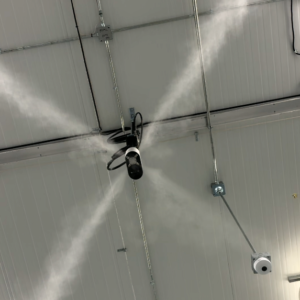
Investing in modern high-pressure fog humidification systems can significantly benefit your woodworking operations. An advanced industrial humidification system for woodworking disperses ultra-fine water droplets that evaporate instantly, raising humidity levels while simultaneously suppressing airborne dust.
Advantages of Installing Industrial Humidification Systems for Woodworking:
- Precise Zone Control: Adjust humidity levels in different areas of your facility based on specific needs, ensuring consistent conditions throughout.
- Protection for Adhesives and Finishes: Safeguard your products from the adverse effects of fluctuating humidity and dust presence, ensuring quality at every stage.
- Enhanced Worker Comfort: Improved air quality leads to better working conditions. Dust control in woodworking manufacturing contributes to higher employee satisfaction.
- Energy Efficiency: Modern systems are designed to minimize operating costs, providing a sustainable solution for your facility’s humidity control and dust suppression needs.
Read The Complete Guide to Manufacturing Humidification: Protecting Quality, Efficiency, and Safety for more insight on how high-pressure humidification systems support a wide range of industries.
Frequently Asked Questions
Why is humidity control crucial for my woodworking business?
Humidity control is essential for maintaining the quality of your products and ensuring worker safety. It directly affects the dimensional stability of your wood, adhesive performance, and overall air quality.
What problems can arise from improper humidity levels?
Too low humidity can lead to wood shrinking and warping, while high humidity can cause swelling and tacky finishes. Both scenarios undermine product quality and can lead to increased operational inefficiencies.
How does stable humidity improve adhesive performance?
Stable humidity ensures optimal curing conditions for adhesives used in woodworking, enhancing bond strength and reducing the risk of joint failures, ultimately leading to a more reliable product.
How does humidity impact surface finishes?
Ideal humidity levels support smooth application and proper curing of finishes, preventing defects such as bubbling and cracking.
What advantages do high-pressure fog humidification systems offer?
These advanced systems create ideal humidity conditions, enhance air quality in woodworking plants, reduce dust accumulation, and contribute to a safer, more efficient workspace.